Building your own cloud with OpenStack

Building your own cloud with OpenStack
Photo by Taylor Vick / Unsplash

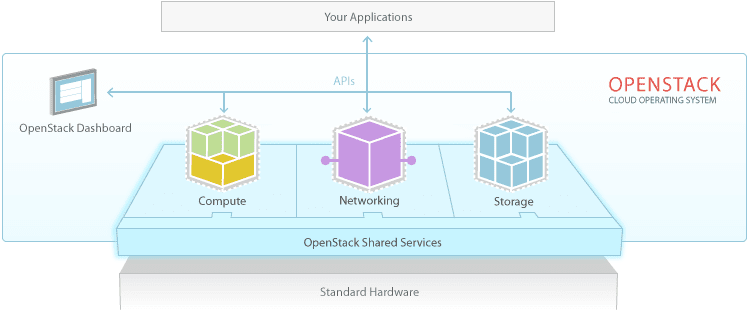
OpenStack is a cloud operating system that controls large pools of compute, storage, and networking resources throughout a datacenter, all managed through a dashboard that gives administrators control while empowering their users to provision resources through a web interface.

OpenStack is invented by Rackspace and NASA. Sounds cool, right?

Others companies like HP, IMB, Red Hat and Dell are using OpenStack for serving cloud computing. Ubuntu, for example, offers Ubuntu OpenStack for build custom cloud ready to go.

OpenStack can manage compute, storage and networking from a simple dashboard. Check out the following image. Also, we can config and manage all the resources throw the complete API.

Feel free to get SDKs libraries and test yourself.
Check out the dashboard working on this video demo:

You can download and run OpenStack for free, install it on your own datacenter (for public or private clouds), and build the next IaaS.


Read more

How to Build Your Own Internal Developer Platform (IDP) Using Crossplane

How to Build Your Own Internal Developer Platform (IDP) Using Crossplane

In the modern cloud-native landscape, the friction between operation stability and developer velocity remains a critical bottleneck. As organizations scale, the manual ticketing systems traditionally used to provision infrastructure become unsustainable. The solution lies in platform engineering: building an Internal Developer Platform (IDP) that enables self-service capabilities without sacrificing governance

By Allan Porras
Orchestrating State: Building and Deploying Stateful Applications on Kubernetes with Operators

Orchestrating State: Building and Deploying Stateful Applications on Kubernetes with Operators

While Kubernetes excels at managing stateless microservices via standard Deployments and ReplicaSets, managing stateful applications—such as databases, message queues, and distributed caches—introduces significant complexity. These applications require stable network identities, persistent storage, and ordered deployment and termination. To solve this in an automated, scalable manner, high-performing engineering teams

By Allan Porras